A brochure website usually answers the basic questions. Who are you. What do you do. How do I contact you. That is fine if the business is mainly operating through referrals, repeat custom, or a market where nobody expects much online.
But the moment a company wants to look high-trust, command better pricing, or win a more selective kind of customer, the job changes. Information is no longer enough. Now the website has to create a sequence.
Premium buyers read for signals
This is the part I think many owners underestimate. People do not visit a website like a machine. They visit it with instinct. They are reading for quality before they are reading for facts. They are looking for signs that the business is serious, organised, and worth trusting.
That is why weak websites fail quietly. A visitor may never consciously think, this navigation is clumsy or this copy feels thin. They just leave with less confidence than they arrived with.
Trust is built through sequence, not decoration
A lot of people hear the word premium and immediately think visuals. Better fonts. Stronger colours. Nice motion. Those things matter, but they are not the core of it. The real upgrade is structure.
What does the visitor see first. When do they understand what makes the business different. Where do they encounter proof. How quickly do they feel that the business knows what it is doing. Is the enquiry path clean or awkward. Does the site remove doubt or quietly create more of it.
Those questions matter more than whether the header is centred or whether the button has a gradient. Decoration can improve a site. It cannot rescue weak sequence.
The site has to reduce the sales burden
One of the clearest signs of an underpowered site is that the business owner still has to over-explain everything in person. Every call starts from zero. Every lead needs the same reassurance. Every proposal has to do the heavy lifting the site should have already started.
A stronger website does not replace sales, but it does precondition the conversation. It handles the first layer of trust. It frames the offer properly. It gives the person arriving some sense that the business is worth taking seriously before a single message is sent.
That matters even more for founder-led businesses and smaller studios, because the website often becomes the first proof that the team behind it is operating at a higher level than their size suggests.
What we build instead
When AH Studio talks about premium work, this is what I mean. Not just visually polished sites, but sites that understand positioning, sequencing, and commercial pressure. Pages with rhythm. Proof that is legible. Clear pathways. Less generic agency language. More intent.
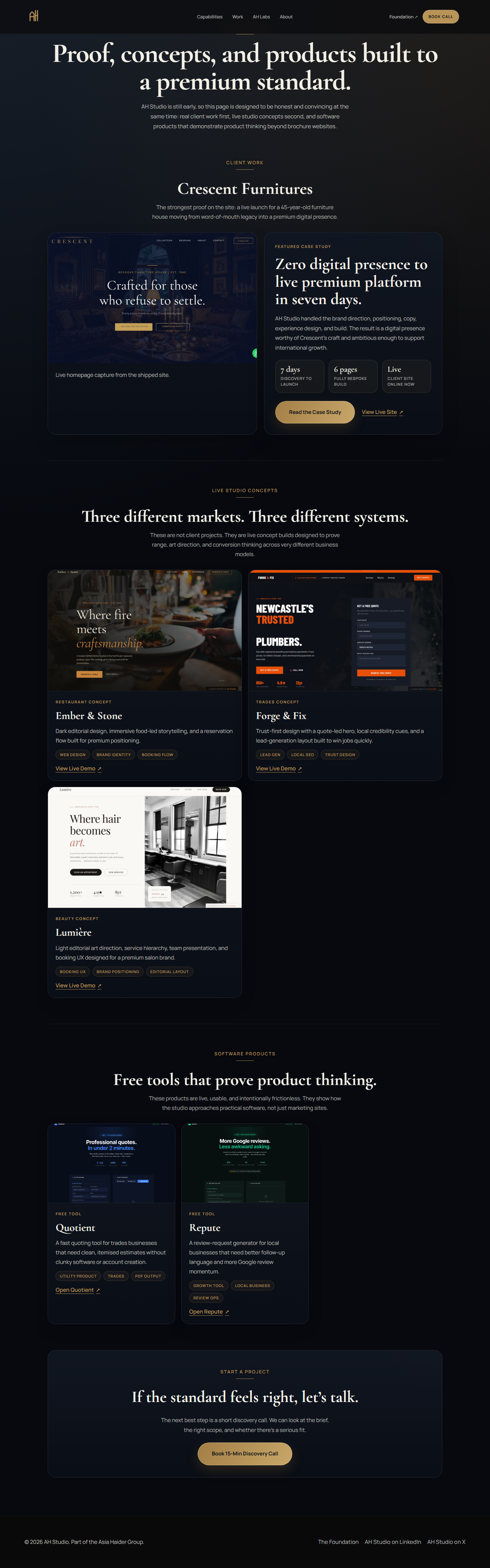
That is why the Work page is structured the way it is. Real client proof first. Live concepts second. Product work after that. It is also why the Crescent build note matters. People should be able to see the standard and then read how the thinking behind it works.
Brochure websites are not beneath me. They are just often beneath the ambition of the businesses asking for them.
The practical version of this idea
If you are a premium business, the website should probably be doing at least four jobs well. It should position you clearly. It should make trust easier. It should remove friction from the next step. And it should leave a stronger impression than a templated competitor site built from the same five blocks everyone else uses.
If it is only doing one of those, it might still be live, but it is not really working hard enough.